 Schildmark
Platform
Patching that runs itself, and proves it
The analyst finds the vulnerable package and proposes the fix. With unattended approval on, routine fixes go out without anyone stepping in: rehearsed on the machine first, installed in its maintenance window, and counted as done only when the vulnerability is confirmed fixed.
From question to verified fix
Ask the analyst what is exploitable, or open an alert. It names the package, the machines and the fixed version in plain words, and proposes the fix. Turn on unattended approval and routine fixes go out on their own: rehearsed first, verified after. Critical machines still wait for two people.

Google Chrome on 14 Windows laptops has a vulnerability that attackers are using.
CVE-2025-6554 is a type confusion in V8, Chrome’s JavaScript engine: a crafted web page can read and write memory it should not reach. It was exploited before the fix was out and is on CISA’s list of known exploited vulnerabilities. Chrome 138.0.7204.96 fixes it; update all 14 laptops.
- CVE
CVE-2025-6554- Severity
- High
- Known exploited
- Yes, CISA KEV
- Machines
- 14 Windows laptops
- Fixed in
138.0.7204.96- Channel
- winget (pilot)
137.0.7151.120 138.0.7204.96
Unattended approval: on for laptops, low risk
- Verify
- Plan
- Dry run
- Approved automatically by policy
- Installed
- Verified
OpenSSH on 3 Ubuntu servers can be attacked without a password.
CVE-2024-6387, known as regreSSHion, is a race condition in a signal handler of sshd. On glibc-based Linux, an attacker who can reach the SSH port may run code as root without signing in. OpenSSH 8.5p1 to 9.7p1 are affected; on Ubuntu 22.04 the fix is openssh-server 1:8.9p1-3ubuntu0.10.
- CVE
CVE-2024-6387- Severity
- High
- Machines
web-01,web-02,app-03- Affected
- OpenSSH 8.5p1–9.7p1
- Fixed in
1:8.9p1-3ubuntu0.10- Channel
- apt
openssh-server 1:8.9p1-3ubuntu0.10
Unattended approval: on for web servers, low risk
- Verify
- Plan
- Dry run
- Approved automatically by policy
- Installed
- Verified
Two Macs run a Homebrew curl with a heap overflow.
CVE-2023-38545 is a heap buffer overflow in curl’s SOCKS5 proxy handshake, triggered by a very long host name. curl 7.69.0 to 8.3.0 are affected and 8.4.0 fixes it; Schildmark can update the Homebrew package. hr-lap-2 also waits for a macOS update: that one is installed on the Mac itself.
- CVE
CVE-2023-38545- Machines
hr-lap-2,design-mac-1- Installed
- curl 8.3.0 (Homebrew)
- Fixed in
8.4.0- Channel
- Homebrew (pilot)
- macOS update
- Detected; install on the Mac
8.3.0 8.4.0
Unattended approval: on for laptops, low risk
- Verify
- Plan
- Dry run
- Approved automatically by policy
- Installed
- Verified
Demo with sample data. CVE details are real. Windows and macOS patching are in pilot; macOS system updates are detected and explained, then installed on the Mac itself.
Every fix takes the same six steps
Whether a person approves it or the policy does, nothing is skipped. Unattended approval applies only to environments you list, to machines that are not high or critical, and to plans with nothing restricted; such jobs say Approved automatically by policy.
Verify
The job starts from a confirmed finding and reads the machine’s current state.
Plan
The exact package version, or Windows KB, that fixes it is chosen.
Dry run
The install is rehearsed on the machine without changing it.
Approve
A person, or the unattended-approval policy you turned on. Critical machines need two different people.
Install
In the machine’s maintenance window, and only with restarts it allows.
Verify the fix
Done only when the version is in place and the vulnerability is confirmed fixed.
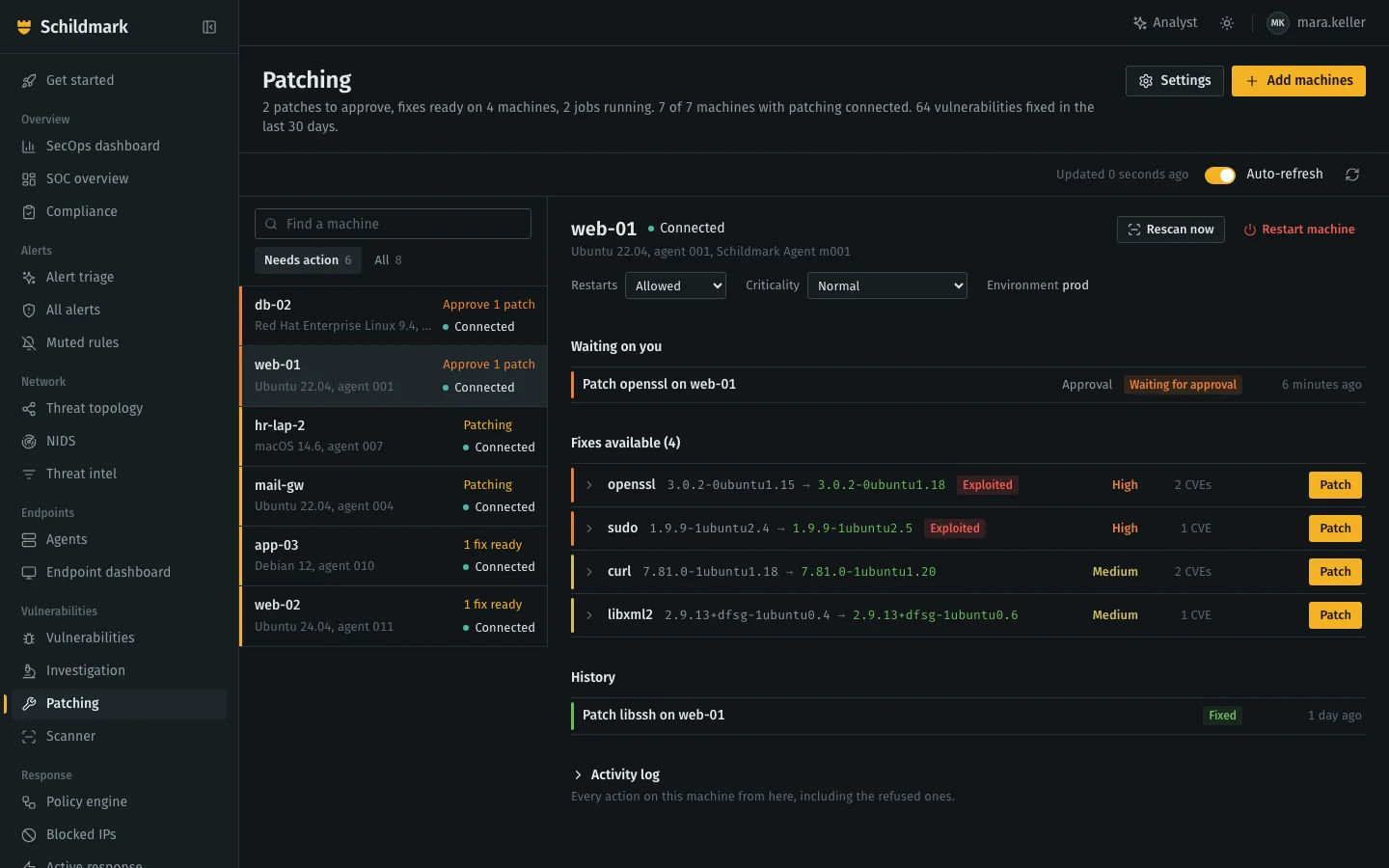
- The fleet in one sentence. What waits for approval, what is running, how many fixes were verified in 30 days.
- Machines that need you first. Each says in a few words where it stands.
- Waiting on you. Rehearsed jobs that need a decision.
- Exploited. Fixes for vulnerabilities known to be exploited are marked.
- History. Including fixes made outside Schildmark, such as an automatic update overnight.
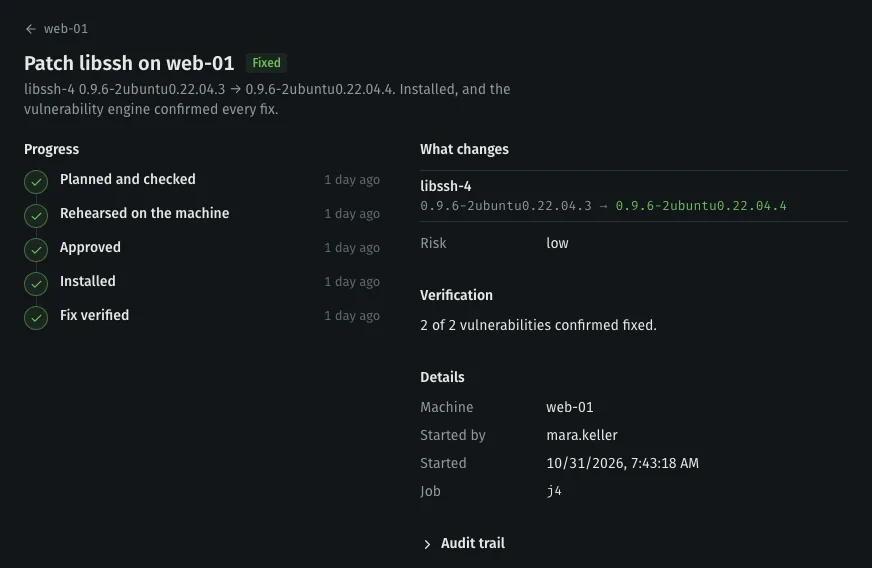
Installed is not the same as fixed
A job ends Remediated only when the installed version is at least the target, the machine’s software list shows it, and verification reports every fixable vulnerability of the job as fixed. Otherwise it says Not verified or Reboot required, never done.
Safety you set per machine
- Maintenance window
- Scheduled jobs wait for it; restarts outside it are refused.
- Restarts
- Allowed or not. Without permission, no patch and no person can restart the machine.
- Criticality
- Critical machines need two approvers and are never approved unattended.
- Deny list
- Packages such as container runtimes need escalated approval.
- Rollouts
- One package across rings of machines; the next ring starts only when the one before has succeeded.
- Accepted risks
- When a fix cannot be installed, record the owner, the reason and an expiry instead.
What it installs from
| Channel | Status |
|---|---|
| apt, dnf (Linux) | Available |
| Windows Update KBs | Pilot |
| winget, pip | Pilot |
| Homebrew (macOS) | Pilot |
| macOS system updates, other third-party applications | Install on the machine; the console shows them as fixed when they are |
Patching uses the same Schildmark Agent, installed with --patching. It connects out only, signs every request, and runs only jobs your console signed, from a fixed list of actions. There is no shell and no “run command”.
Talk to sales
Tell us about your machines, your firewalls and the audit you are preparing for. We answer within one working day.