 Schildmark
Platform
Ask your alerts a question
Schildmark Analyst answers questions about your environment in plain language and runs the investigation behind the answer, over your alerts, vulnerabilities, inventory and connected services. You decide whether it runs, and where its requests may go.
From a question to a patched machine
The analyst finds what is exploitable, explains it so you know what to do, and proposes the fix. With unattended approval on for those machines, the fix runs without anyone stepping in, and the vulnerability scan confirms it.

Google Chrome on 14 Windows laptops has a vulnerability that attackers are using.
CVE-2025-6554 is a type confusion in V8, Chrome’s JavaScript engine: a crafted web page can read and write memory it should not reach. It was exploited before the fix was out and is on CISA’s list of known exploited vulnerabilities. Chrome 138.0.7204.96 fixes it; update all 14 laptops.
- CVE
CVE-2025-6554- Severity
- High
- Known exploited
- Yes, CISA KEV
- Machines
- 14 Windows laptops
- Fixed in
138.0.7204.96- Channel
- winget (pilot)
137.0.7151.120 138.0.7204.96
Unattended approval: on for laptops, low risk
- Verify
- Plan
- Dry run
- Approved automatically by policy
- Installed
- Verified
OpenSSH on 3 Ubuntu servers can be attacked without a password.
CVE-2024-6387, known as regreSSHion, is a race condition in a signal handler of sshd. On glibc-based Linux, an attacker who can reach the SSH port may run code as root without signing in. OpenSSH 8.5p1 to 9.7p1 are affected; on Ubuntu 22.04 the fix is openssh-server 1:8.9p1-3ubuntu0.10.
- CVE
CVE-2024-6387- Severity
- High
- Machines
web-01,web-02,app-03- Affected
- OpenSSH 8.5p1–9.7p1
- Fixed in
1:8.9p1-3ubuntu0.10- Channel
- apt
openssh-server 1:8.9p1-3ubuntu0.10
Unattended approval: on for web servers, low risk
- Verify
- Plan
- Dry run
- Approved automatically by policy
- Installed
- Verified
Two Macs run a Homebrew curl with a heap overflow.
CVE-2023-38545 is a heap buffer overflow in curl’s SOCKS5 proxy handshake, triggered by a very long host name. curl 7.69.0 to 8.3.0 are affected and 8.4.0 fixes it; Schildmark can update the Homebrew package. hr-lap-2 also waits for a macOS update: that one is installed on the Mac itself.
- CVE
CVE-2023-38545- Machines
hr-lap-2,design-mac-1- Installed
- curl 8.3.0 (Homebrew)
- Fixed in
8.4.0- Channel
- Homebrew (pilot)
- macOS update
- Detected; install on the Mac
8.3.0 8.4.0
Unattended approval: on for laptops, low risk
- Verify
- Plan
- Dry run
- Approved automatically by policy
- Installed
- Verified
Demo with sample data. CVE details are real. Windows and macOS patching are in pilot; macOS system updates are detected and explained, then installed on the Mac itself.
More it answers
Plain questions, answered from your own alerts, machines and vulnerabilities. Every answer shows what it was based on, and the actions it offers follow your role.
Demo with sample data.
Likely malicious, but nothing got in.
- Verdict
- Likely malicious
- Evidence
- 600 failed SSH logins on
web-01from203.0.113.45in 24 hours; none succeeded. The address reached no other host. - Reputation
- AbuseIPDB score 100
- Next step
- Block the address at the perimeter; keep the rule on.
Three changes, one of them worth a look.
- 09:22
- openssl updated to
3.0.2-0ubuntu1.18by a patch job; fix verified. - 14:10
/etc/nginx/sites-enabled/appchanged (file integrity).- 16:42
- New local user
deploycreated with sudo rights. Nobody on your team has claimed it yet.
A quiet night, two things for today.
- Alerts
- 12 critical, 148 high in 24 hours; 9 of the critical ones are the same brute force, already blocked.
- Patching
- 7 fixes verified overnight; 1 job waits for a second approver on
db-02. - Machines
fin-lap-7has not reported for 26 hours.- Today
- Approve the db-02 job; ask the owner of fin-lap-7.
None. The last three were fixed yesterday.
- Fixed
web-01,web-02,app-03: openssh-server1:8.9p1-3ubuntu0.10, verified 02:58.- Not affected
bastion-01runs OpenSSH 8.2p1, older than the affected range.- Still to check
build-3has never reported its software list.
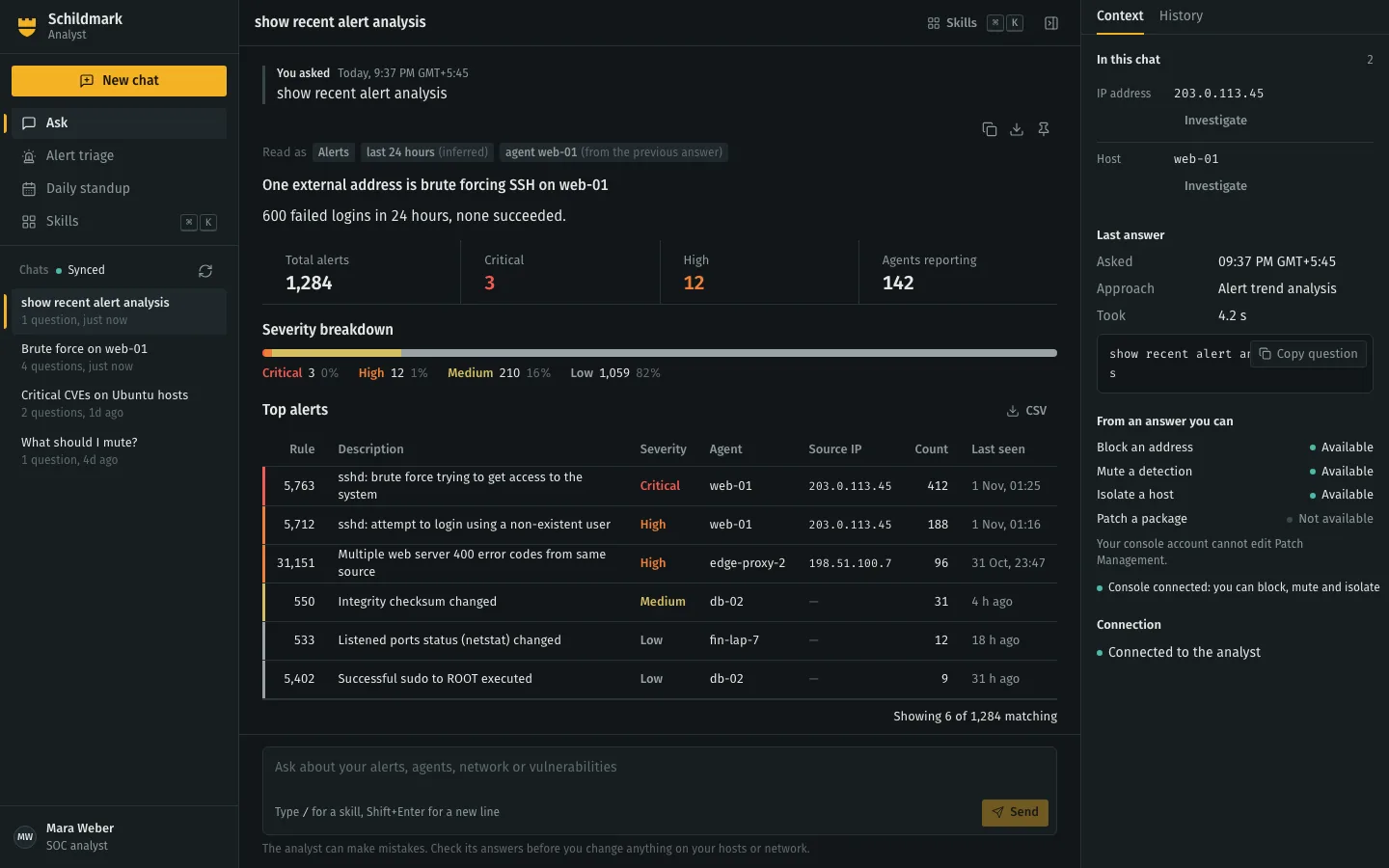
- How it read the question. Data source, period and host, including what it inferred.
- The answer first. Then the figures and the alerts it is based on.
- What it may do. Actions follow your role’s permissions and the protected addresses.
- Check before you act. The analyst can make mistakes, and says so.
Your AI data policy
Questions and the data the analyst reads go to a language model. Which one is your decision, and the hosted analyst’s gateway enforces it on every request.
Off
Every request is refused, and the analyst says AI is switched off. Nothing leaves.
Standard
Requests go through our LLM gateway to our standard AI provider, within a monthly allowance for your organisation.
BAA only
Requests go only to a provider that has signed a business associate agreement (HIPAA) with us. If none is available, they are refused, never sent elsewhere.
No BAA-covered provider is in service yet, so today BAA only refuses every request. Ask us before choosing it.
Your own model
Without the hosted analyst, it uses the OpenAI-compatible endpoint you configure: vLLM or Ollama on your own hardware, Azure OpenAI, or another provider whose data handling suits you.
We do not “redact” logs and call it HIPAA: names in log lines cannot be found reliably. The policy decides where data may go instead.
What it does
- Ask
- “Which hosts talked to this IP?” “What changed on web-01 yesterday?” Threads are kept.
- Alert triage
- Alerts grouped into incidents, with a narrative of what happened.
- Daily standup
- A summary of the last day.
- Act
- Acknowledge, close, mute, block at the perimeter, propose a patch, or open a Jira ticket.
Where it runs
- On your stack
- The analyst runs beside your console and calls the model endpoint you set. Conversations stay in your stack.
- Hosted analyst
- An add-on: we run it for you with our LLM gateway, in containers of your own. Its conversations are still stored in your stack; the alert data it reads leaves your infrastructure while it works.
- When the model is down
- It still returns the data it found and says that manual review is needed.
Talk to sales
Tell us about your machines, your firewalls and the audit you are preparing for. We answer within one working day.